


Masjid al-Fath
Masjid al-Fath (Arabic: مسجد الفتح) is a mosque which marks the location where the Prophet ﷺ camped alongside 10,000 companions, en route to conquer Makkah. It is situated in the al-Jumum governorate in the Makkah al-Mukarramah province.
Table Of Content
Name
The mosque was named Masjid al-Fath (Mosque of Conquest) because of the site’s association with the Conquest of Makkah which took place in 8 AH (630 CE).
History
Expedition of Zaid ibn Haritha
Masjid al-Fath is also located in the vicinity where a group of Muslims were sent to confront the Banu Salim tribe. In 8 AH (629 CE), the Prophet ﷺ dispatched a battalion under the command of his adopted son, Zayd ibn Haritha I, to al-Jumum. En route, they captured a woman from the Banu Muzaina tribe who guided them to Banu Salim’s camp. This resulted in the capture of enemies from the tribe and the acquisition of a substantial amount of booty. Following the expedition, the Prophet ﷺ freed the woman and married her to one of his companions.
Conquest of Makkah
On the 10th of Ramadan in the year 8 AH (630 CE), the Prophet Muhammad ﷺ set out for Makkah with an army of 10,000 companions. However, some accounts mention a total of 12,000 soldiers. This discrepancy can be explained by the possibility that when the Messenger of Allah ﷺ left Madinah, he initially had 10,000 companions, but this number increased to 12,000 as additional tribes joined him on the journey to Makkah.
As the Prophet ﷺ and his companions departed from Madinah, they were fasting. However, upon reaching al-Kadeed, situated between Usfan and Qudayd, the Messenger of Allah ﷺ requested water. He drank it while still on his she-camel and then broke his fast. Following his lead, the companions also broke their fast. The decision was made considering the circumstances of engaging in Jihad and travelling.
Ibn Abbas I said:
Allah’s Messenger ﷺ fought the Ghazwa (i.e. battles of Al-Fath during Ramadan). The Prophet ﷺ fasted and when he reached Al-Kadeed, a place where there is water between Qudayd and Usfan, he broke his fast and did not fast afterwards till the whole month had passed.
[Narrated in Sahih al-Bukhari]
At Mar al-Zahran
The Muslim army established their camp upon arriving at Mar al-Zahran, where Masjid al-Fath stands today. Here, the Prophet Muhammad ﷺ instructed each soldier to light their own fire. As night fell, the collective glow of the fires from all 10,000 soldiers created a breathtaking sight, resembling a vast and radiant sea of fire that stretched for miles, illuminating the surrounding area.
Enemy Spies
The Quraysh, upon learning of the approaching Muslim army, dispatched Abu Sufyan ibn Harb, Hakim ibn Hizam, and Budayl ibn Warqa as spies to gather intelligence. Meanwhile, Abbas contemplated the dire fate that awaited the Quraysh if they faced the mighty Muslim army. Concerned for them, he undertook a nighttime journey on the white mule of the Prophet Muhammad ﷺ to Makkah. His intention was to warn the Quraysh of the impending danger and persuade them to seek forgiveness from the Prophet ﷺ and establish a pact with him.
Unaware that the Muslim army had already reached Mar al-Zahran, the appointed spies were astonished when they arrived near the camp and witnessed the expansive sea of fire stretching for miles. Abu Sufyan ibn Harb remarked on the unprecedented scale of the fire, while Budayl ibn Warqa speculated it could be the work of the Banu Khuza’ah tribe. However, they were soon intercepted by Abbas.
Upon encountering the spies, Abbas informed them of the true nature of the fires, identifying them as the campfires of the Muslim army. Concerned for their safety, he offered Abu Sufyan ibn Harb a seat on his mule to avoid detection. However, upon entering the Muslim camp, they were recognized by Umar I, who immediately sought permission to apprehend Abu Sufyan. Abbas intervened, bringing the three spies before the Prophet Muhammad ﷺ and pleading for their lives, citing his granted protection over them.
Abu Sufyan Accepts Islam
Abu Sufyan’s hostility towards Islam was evident through his actions, including causing distress to the Prophet ﷺ, attacking Madinah multiple times, and collaborating with the Jews to plot the Prophet’s ﷺ assassination. By conventional standards, such actions could have warranted severe consequences, even death. However, in the eyes of the Prophet Muhammad ﷺ, known in the Quran as ‘Ra’uf’ (affectionate) and ‘Rahim’ (compassionate), there was room for mercy and forgiveness.
According to a narration in Sahih al-Bukhari, upon entering the presence of the Prophet Muhammad ﷺ, Abu Sufyan immediately recited the kalimah, which spared him from certain death. Another account suggests that Hakim ibn Hizam and Budayl ibn Warqa embraced Islam that very night, while Abu Sufyan declared his testimony of faith the following morning. Regardless of the timing, these events marked a significant turning point in Abu Sufyan’s life as he embraced Islam, setting aside his enmity and accepting the message of the Prophet Muhammad ﷺ.
After leaving the camp, the Muslim army marched towards Makkah. Upon entering, they were met with little resistance and successfully conquered the blessed city.
Development of Masjid al-Fath
This mosque has undergone several renovations and rebuilds throughout history, with the current structure completed in 1398 AH (1977 CE). The mosque features a 5-metre-wide courtyard adorned with a tall minaret on the left-hand side, accompanied by an adjacent room.
In 2022, the mosque was chosen as part of a Saudi initiative to develop historical mosques. Before restoration, the mosque covered an area of 456 square metres, which increased to 554 square metres after the restoration process. As a result, the mosque’s capacity expanded, accommodating between 218 to 333 worshipers.
Architecture
Masjid al-Fath was constructed in the style of traditional Hijazi architecture, employing materials sourced from the local environment such as bricks, basalt stone, gypsum, and wood. One notable architectural feature of the mosque is the prominent use of rawashin, which can be observed in the intricately crafted wooden panels covering the windows and external openings. This wooden element is a hallmark of Hijazi architecture, serving to regulate temperatures within the mosque and promote a comfortable environment for worshipers.
Furthermore, the architectural design of Masjid al-Fath incorporates rattan screens as a distinctive element. These screens adorn the main spaces of the mosque while facilitating sunlight entry. They not only add aesthetic appeal but also serve practical purposes, enhancing ventilation within the mosque.
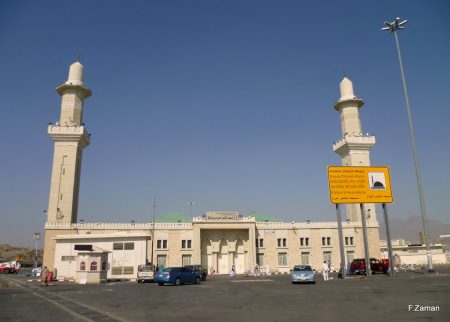


I believe it is the same location as the masjid is at Mar al-zahran
This is not Masjid Fatah, the one linked with Prophet SAW is in Jumum where tent of Prophet SAW was located . The location is : https://maps.app.goo.gl/egAZf9XMPz7HwMUo6