Cave of Thawr
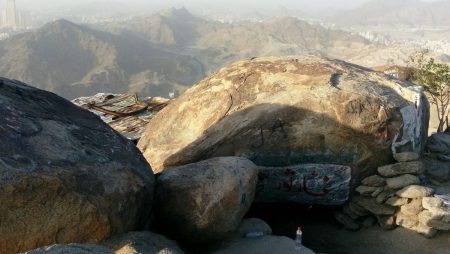
The Cave of Thawr (Arabic: غار ثور; “Ghar Thawr” or “Ghar e Soor”) is famous for having sheltered the Prophet ﷺ and his close companion Abu Bakr al-Siddiq I from Makkan search parties as they were migrating from Makkah to Madinah. It is located near the summit of Jabal Thawr, a mountain located four kilometres south of Makkah.
Table Of Content
Description
The Cave of Thawr resembles a spacious hollow, resembling a ship. It is approximately 748 meters above sea level and is near the summit of Jabal Thawr.
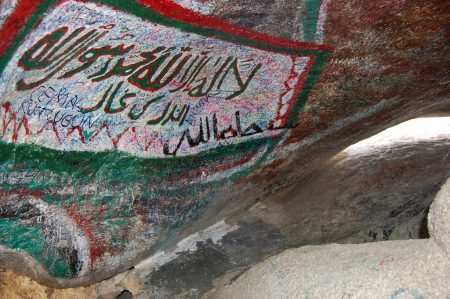
Notably, the cave features two openings: one on the west side, believed to be the entrance used by the Prophet Muhammad ﷺ and Abu Bakr al-Siddiq I and another on the east side.
The interior dimensions of the cave measure 1.25 metres in height, 3.5 metres in length, and 3.5 metres in width. Previously, accessing this entrance required individuals to lie down due to its limited height. However, this entrance was expanded over the years, resulting in its current height of approximately one metre.
The other entrance on the eastern side is wider and was intentionally constructed to facilitate easy entry and exit from Ghar e Soor. It is positioned 3.5 meters away from the western entrance.
Ghar e Soor History
The Migration
The Prophet Muhammad ﷺ instructed his companions in Makkah to migrate to Madinah and join their fellow Muslims, the Ansar. He assured them that Allah had provided them with brothers and a safe haven in Madinah. Following his directive, they departed Makkah in groups. Meanwhile, the Prophet ﷺ himself remained in Makkah, awaiting Allah’s permission to migrate.
Gradually, prominent figures such as Umar ibn al-Khattab, Talhah, Hamzah, Zayd ibn al-Harithah, Abd al-Rahman ibn Awf, al-Zubayr ibn al-Awwam, Abu Hudhayfah, Uthman ibn Affan, and others M embarked on the journey, initiating the migration process. This migration continued until all Muslims had left Makkah, except for those imprisoned or facing persecution for their faith, along with Ali ibn Abi Talib and Abu Bakr ibn Abi Quhafah M.
The Kuffar Plot
When the Quraysh realized the gravity of the situation, they convened in Dar al-Nadwah, a significant gathering place for decision-making. Along with them was Iblis (Shaytan), disguised as an elderly Najdi sheikh. They deliberated on how to handle the growing influence of the Prophet ﷺ, fearing that if he gained prominence, other Arab tribes might support him. Ultimately, they resolved to assassinate him.
However, before they could carry out their plan, the angel Jibril S appeared to the Prophet Muhammad ﷺ, warning him not to spend the night in his bed. He instructed Ali I to take his place. Ali, obedient to the Prophet’s ﷺ command, slept in his bed, covering himself with a green striped cloak.
When the Prophet Muhammad ﷺ from his home, where the would-be assassins were waiting, Allah veiled their sight, preventing them from seeing him. He scattered soil over their heads while reciting the opening verses of Surah Yasin.
The Prophet ﷺ Departs
Later, the Prophet ﷺ informed Abu Bakr that Allah had granted him permission to migrate. Overwhelmed with joy, Abu Bakr asked if they would migrate together, to which the Prophet ﷺ affirmed. In his excitement, Abu Bakr prepared two camels for the journey and hired a guide named Abdullah ibn Urayqit.
The Prophet Muhammad ﷺ and Abu Bakr discreetly departed from Makkah, with only Ali and Abu Bakr’s family M aware of their departure. Abu Bakr had instructed his son, Abdullah ibn Abi Bakr I, to listen in on conversations in Makkah, while his freed slave, Amir ibn Fuhayrah I, tended to his sheep during the day and returned them to their farm at night. Asma bint Abi Bakr J provided them with food.
At the Cave of Thawr
Upon reaching Ghar e Soor, Abu Bakr entered the cave first, tidying and patching any holes with shreds of his clothing. Unable to fill one hole completely, he covered it with his heel. When the Messenger of Allah ﷺ joined him in the cave, he rested his head on Abu Bakr’s lap before drifting off to sleep.
As the Prophet ﷺ rested, a snake bit Abu Bakr repeatedly on the heel covering the hole. Enduring the pain silently, Abu Bakr refrained from moving his foot to avoid disturbing the Prophet’s ﷺ sleep. However, as the pain grew unbearable, tears escaped his eyes and fell upon the Prophet’s ﷺ blessed cheeks, awakening him.
Concerned, the Prophet ﷺ inquired about Abu Bakr’s distress. Learning of the snakebite, he applied his blessed saliva to the wound, instantly relieving the pain and healing the injury.
They remained in the Cave of Thawr for three nights, with Abu Bakr’s son, Abdullah I, standing guard at the entrance during the nights. Each morning, he would return to Makkah to gather intelligence on the plans of the disbelievers, informing the Prophet ﷺ in the evenings. Additionally, Amir ibn Fuhayrah I, Abu Bakr’s slave, visited the cave daily, bringing milk from his goats for the Prophet ﷺ and Abu Bakr.
According to narrations from Anas bin Malik, Zayd bin Arqam, and al-Mughirah bin Shu’bah M, on the Night of the Cave, Allah commanded a tree to grow right in front of the Prophet ﷺ, concealing him from view. Additionally, two wild pigeons were commanded to perch at the mouth of the cave. As the young men of the Quraysh approached from all directions, armed with sticks, staffs, and swords, they came within forty arms’ lengths of the Prophet ﷺ.
One of them hurried to peer into the Cave of Thawr but only saw the two wild pigeons at the entrance. Returning to his companions, he reported that he saw nothing but birds, concluding that no one was inside. The Prophet ﷺ, hearing this, realized that Allah had diverted their attention away from him, thus ensuring his safety.
Hearing the approaching footsteps of the disbelievers, Abu Bakr informed the Messenger of Allah ﷺ about their proximity, fearing discovery. In response, the Prophet ﷺ reassured him, citing the verse from Surah al-Tawbah (9:40): “Grieve not! Surely, Allah is with us.” This declaration instilled tranquility in Abu Bakr’s heart, dispelling his anxiety, and he became completely fearless. Abu Bakr narrated:
I said to the Prophet ﷺ while I was in the Cave. ‘If any of them should look under his feet, he would see us.’ He said, ‘O Abu Bakr! What do you think of two (persons) the third of whom is Allah?’
[Narrated in Sahih al-Bukhari]
This incident is mentioned in the Quran:
إِلَّا تَنصُرُوهُ فَقَدْ نَصَرَهُ ٱللَّهُ إِذْ أَخْرَجَهُ ٱلَّذِينَ كَفَرُوا۟ ثَانِىَ ٱثْنَيْنِ إِذْ هُمَا فِى ٱلْغَارِ إِذْ يَقُولُ لِصَـٰحِبِهِۦ لَا تَحْزَنْ إِنَّ ٱللَّهَ مَعَنَا ۖ فَأَنزَلَ ٱللَّهُ سَكِينَتَهُۥ عَلَيْهِ وَأَيَّدَهُۥ بِجُنُودٍۢ لَّمْ تَرَوْهَا وَجَعَلَ كَلِمَةَ ٱلَّذِينَ كَفَرُوا۟ ٱلسُّفْلَىٰ ۗ وَكَلِمَةُ ٱللَّهِ هِىَ ٱلْعُلْيَا ۗ وَٱللَّهُ عَزِيزٌ حَكِيمٌ
Even if you do not help the Prophet, God helped him when the disbelievers drove him out: when the two of them were in the cave, he (Muhammad) said to his companion, ‘Do not worry, God is with us,’ and God sent His calm down to him, aided him with forces invisible to you, and brought down the disbelievers’ plan. God’s plan is higher: God is almighty and wise.
[Surah al-Tawbah, 9:40]
Suraqah ibn Malik
Suraqah ibn Malik ibn Ja’sham was driven by his desire for the reward of a hundred she-camels to pursue the Prophet ﷺ and return him to Quraysh. Despite facing obstacles, he persisted in his pursuit. As he galloped after them, his horse stumbled, and he fell, but he refused to give up. Even after a second fall, he continued his chase. However, when he saw the Prophet ﷺ, Abu Bakr, and their guide ahead of him, his horse stumbled again, sinking its legs into the earth. Realizing his predicament, Suraqah pleaded with the Prophet ﷺ for help and promised to abandon his pursuit. The earth gripped his horse’s legs multiple times as he fell off.
Upon witnessing the miraculous protection surrounding the Messenger of Allah ﷺ, Suraqah ibn Ja’sham recognized that victory was assured for him by the will of Allah. He approached the group and assured them that he harboured no ill intent, introducing himself as Suraqah ibn Ja’sham. The Prophet Muhammad ﷺ then asked Abu Bakr to inquire about his intentions. Suraqah requested a sign of recognition between them, prompting Amir ibn Fuhayrah to write a letter on a piece of bone or cloth.
In response, the Prophet ﷺ foresaw Suraqah’s future wearing the bracelets of Khosrow, the ruler of Persia. This prophecy materialized during the caliphate of Umar ibn al-Khattab I when Persia was conquered. Suraqah I indeed presented himself before Umar with the bracelets, belt, and crown of Khosrow. Umar honored him by placing the regalia on him, thus fulfilling the prophecy of the Prophet Muhammad ﷺ.
Umm Ma’bad
During their journey, the Prophet ﷺ, along with his companions, encountered Umm Ma’bad al-Khuza’iyyah J, whose goat had fallen behind the herd due to exhaustion. Seeing this, the Prophet ﷺ wiped the udder of the goat with his hand, invoked Allah’s name, and prayed for it. Miraculously, the goat’s milk began to flow abundantly. The Prophet ﷺ then fed the milk to the goat itself and to his companions, quenching their thirst. He drank from it as well and filled a vessel with its milk.
Upon the return of Abu Ma’bad I, he inquired about what had transpired. Umm Ma’bad explained that a blessed man had passed by them, describing him in glowing terms. Recognizing the description, Abu Ma’bad realized that it might be the same man whom the Quraysh were seeking.
Arrival in Madinah
Their guide continued leading them until they reached Quba, a suburb of Madinah, on Monday, the 12th of Rabi al-Awwal. They stopped at the house of Kulthum ibn al-Hadam I, where the Prophet ﷺ performed the Friday prayer (Jumu’ah) with the Banu Salim ibn Awf, marking the first Jumu’ah prayer in Madinah. Afterward, they proceeded to the city itself.
Upon arriving in Madinah, the Prophet’s ﷺ camel knelt down three times at the site that would become his mosque’s entrance. Initially, this area served as a place for drying dates and was owned by the orphans Sahl and Suhayl, under the guardianship of As’ad ibn Zurarah or Mu’adh ibn Afra M. The Prophet ﷺ purchased the land for ten dinars.
He then stayed at the house of Abu Ayyub al-Ansari I, who was one of Abd al-Muttalib’s maternal uncles, for seven months, during which time he settled into his new home in Madinah.
Photo Gallery