Masjid al-Bayah
Masjid al-Bayah (Arabic: مسجد البيعة), also known as Masjid al-Aqaba (مسجد العقبة), is situated near Mina and it is the site where two crucial pledges of allegiance were made by the Ansar of Madinah, which led to the migration of the Prophet ﷺ to the city.
Table Of Content
Historical Background
Masjid al-Bayah marks the site where the oath of allegiance (bay’ah) was given to the Prophet ﷺ by the tribes of Madinah, then known as Yathrib. These oaths of allegiance were the catalyst behind the Prophet’s ﷺ migration to Madinah and the establishment of the first Muslim political entity.
Madinah’s community primarily comprised two major tribes, al-Aws and al-Khazraj, along with several smaller Jewish groups. Despite being idolaters and having intermittent conflicts with one another, the tribes of Aws and Khazraj had frequent dealings with the Jewish community of Madinah. As a result, they were aware of the prophecy about the coming of the Final Messenger of Allah ﷺ. The Jews of Madinah often warned them, saying that soon they would abandon their idols in favour of the teachings of this awaited Messenger. This anticipation was shared by both Jews and Christians, who eagerly awaited his arrival.
The First Meeting
In the 11th year of his Prophethood, the Prophet ﷺ travelled to the plain of Mina during the Hajj season to spread the message of Islam to pilgrims, as was his practice. While at al-Aqabah, six men from the tribe of Khazraj approached him. The Prophet ﷺ inquired about their names and lineage before reciting verses from the Holy Quran and inviting them to embrace Islam. Deeply moved by the recitation, the six recognized him as the Final Messenger, as foretold by the Jews. Motivated by this realization, they embraced Islam. Upon returning to Madinah, they extended invitations to Islam to their families and fellow tribesmen.
The six who embraced Islam during the encounter at al-Aqabah are:
- Abu al-Haytham ibn al-Tayyihan
- Abu Umamah Asad ibn Zurarah
- Awf ibn al-Harith
- Rafi’ ibn Malik
- Qutbah ibn Amir ibn Hadidah
- Jabir ibn Abdullah ibn Ri’ab M
The First Pledge of Allegiance
The First Pledge of Allegiance at al-Aqabah marked a significant turning point in the spread of Islam. Inspired by the initial group of six individuals, twelve more individuals journeyed to Mina (al-Aqabah) the following year and embraced Islam, pledging their allegiance to the Messenger of Allah ﷺ. This pledge became known as Bay’at al-Aqabah al-Ula (The First Pledge at al-Aqabah).
Seeking guidance in their newfound faith, this group of new Muslims requested the Messenger of Allah ﷺ to send someone to teach them about the laws of Islam ﷺ. In response, the Prophet ﷺ selected Mus’ab ibn Umayr I to accompany them to Madinah. Mus’ab took up residence at the house of As’ad ibn Zurara I and tirelessly worked to spread Islam throughout the community. His efforts included personally visiting every house of the Ansar and inviting the people of Madinah to embrace Islam. Each day, one or two people accepted Islam resulting in a rapid expansion of Muslims from Madinah to Quba.
Among those who embraced Islam was Sa’d ibn Mu’adh I, the leader of the tribe of Aws. Initially hesitant, he was eventually swayed by the recitation of the Holy Quran, leading him to accept Islam. His acceptance catalysed the conversion of his entire tribe, Aws, who followed his example and embraced Islam.
The Second Pledge of Allegiance
The Second Pledge of Allegiance at al-Aqabah occurred during the 13th year of Prophethood, coinciding with the Hajj season. Mus’ab ibn Umayr returned to Makkah, while many new Muslims from Yathrib embarked on the pilgrimage alongside their pagan companions. Around 73 Muslim men and women gathered with the Prophet at al-Aqabah in the midst of the night, swearing their allegiance to him and pledging to defend him as they would their own families. To facilitate communication and cooperation between the Prophet and the people of Yathrib, twelve leaders were appointed, nine from the Khazraj tribe and three from Aws.
During this pivotal event, the Prophet’s uncle, Abbas I, who had not yet formally embraced Islam, accompanied him. Addressing the future Ansar (helpers), Abbas emphasized the critical importance of their pledge to protect his beloved nephew.
After this event, the Muslims began to migrate to Madinah.
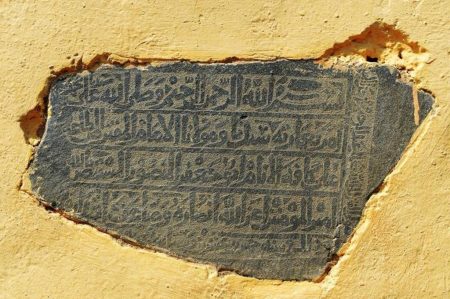
The Abbasid caliphs, descendants of Abbas, later erected a mosque at the site, commemorating the events with an inscription on the exterior surface of the Qibla wall.
The Mosque
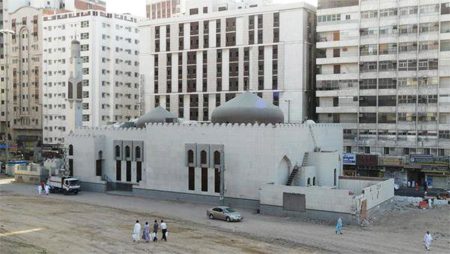
A mosque was initially constructed by the Abbasid Caliph Abu Ja’far al-Mansur in 144 AH (761 AD) at the site where the first and second Aqabah pledges of allegiance had taken place. Situated close to Mina on the right side of one descending from the Jamarat Bridge towards the Masjid al-Haram, it is approximately 500m away from Jamrat al-Aqabah (The Big Jamrat).
Over the years, Masjid al-Bayah underwent numerous renovations, the last significant one occurring during the Ottoman Era. The Saudi Government has preserved its structure to this day.
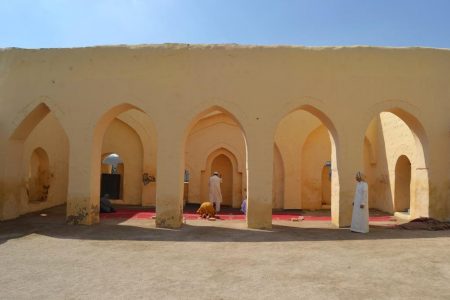
Rectangular in shape, the mosque measures approximately 25 metres in length from east to west and 15 metres in width from north to south, covering an area of approximately 375m². It features two open galleries, one facing the Qibla and the other situated at the end of the mosque.
Photo Gallery