


Hajar al-Aswad
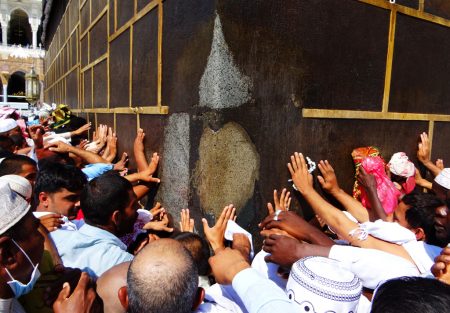
Hajar al-Aswad (Arabic: الحجر الأسود; “The Black Stone”), also spelt Hajr-e-Aswad, is a sacred rock encased with silver located in the southeastern corner of the Kaaba. It is believed to have descended from heaven. According to a tradition of the Prophet ﷺ, it was originally white in colour but eventually turned black as a result of absorbing the sins of man. The Hajar al-Aswad is the starting and end point of each circuit during the rite of Tawaf, at which point pilgrims are supposed to kiss, touch or gesture towards the stone as they pass it as part of a ritual called Istilam.
Table Of Content
Description of the Hajar al-Aswad
The Hajar al-Aswad is located in the southeastern corner of the Kaaba, at the heart of Masjid al-Haram in Makkah. It is also known as the ‘Object from Heaven’ or ‘Star of Paradise’. The Stone comprises seven or eight small black fragments of distinct rock fused together and housed within a silver frame. This arrangement leaves an approximately 30 cm diameter space positioned 1.5 metres above the ground.
It was originally a complete stone. However, over the centuries, it has suffered damage during various incidents, most notably after it was seized by the Qarmatians. As a result, it is now fragmented into eight pieces of different sizes, with the largest piece resembling a date in size. These pieces were carefully affixed to a larger stone and enclosed within a silver frame for protection.
The Hajar al-Aswad is affixed to the southeastern corner of the Kaaba, which is called al-Rukn al-Aswad (the ‘Corner of the Black Stone’). Conversely, another stone, the Hajar as-Sa’adah (the ‘Stone of Felicity’), is positioned at the opposite corner of the Kaaba, called al-Rukn al-Yamani (the ‘Yemeni Corner’), albeit at a slightly lower elevation than the Hajar al-Aswad.
For centuries, the Ottoman Sultans, in their capacity as Custodians of the Two Holy Mosques, maintained the silver frame encircling the Black Stone and the Kiswa adorning the Kaaba. Constant handling by pilgrims led to the gradual deterioration of these frames, necessitating periodic replacements. When the frames became worn out, they were transported back to Istanbul, where they are still preserved today as revered relics within the Topkapi Palace.
Over time, the surface of the Black Stone has been worn down by the touch and kisses of countless pilgrims, resulting in a reddish-brown to black appearance with yellowish particles. Its border, which surrounds it, slightly protrudes above the stone’s surface. Ali Bey provided a description, characterizing it as:
A block of volcanic basalt, sprinkled with small, pointed crystals resembling straw, with rhombic patterns of tile-red on a dark background, akin to velvet or charcoal, except for one protrusion, which is reddish.
The Hajar al-Aswad garnered attention in Western literature through the accounts of European travellers to Arabia during the 19th and early 20th centuries CE. Johann Ludwig Burckhardt, who visited Makkah in 1814, provided an early description of the stone as an irregularly shaped oval with uneven surfaces, approximately eighteen centimetres in diameter. In 1817, Ritter von Laurin had the opportunity to examine a fragment of the Stone, which had been removed by Muḥammad Ali Pasha, the viceroy of Egypt. Von Laurin described it as having a pitch-black exterior and a silver-grey, fine-grained interior, with tiny cubes of a bottle-green material embedded within. Thomas E. Lawrence, famously known as Lawrence of Arabia (1888-1935), also had the chance to see the Hajar al-Aswad.
Among later scholars, the calligrapher Muhammad Tahir al-Kurdi described and illustrated the Black Stone. He stated:
What is visible of the Black Stone in our time, in the middle of the fourteenth century AH, consists of eight small pieces of various sizes. The largest piece is about the size of a single date, which had broken off during previous attacks by ignorant aggressors. Fifty years ago, at the beginning of the fourteenth century AH, fifteen pieces were visible.
Virtues of the Hajar al-Aswad
Numerous Hadiths expound upon the virtues attributed to the Hajar al-Aswad:
Abdullah ibn Umar I narrated that the Prophet ﷺ said:
Touching the Black Stone and the Yemeni Corner indeed erases sins.
[Narrated in Musnad Ahmad]
Abu Hurayrah I narrated that the Messenger of Allah ﷺ said:
The Black Stone (Hajar al-Aswad) came down from Paradise, and it was whiter than milk. Thereafter, the transgressions of the children of Adam blackened it.
[Narrated in Jami’ al-Tirmidhi]
Ibn Hisham I said:
I asked Ata’ I, ‘What has reached you regarding the Black Stone?’ He said, ‘Abu Hurayrah I informed me he heard the Messenger of Allah ﷺ say, ‘whoever interacts with it, it is as if he has interacted with al-Rahman (the All-Merciful).’
[Narrated in Sunan Ibn Majah]
Abu Hurayrah I relayed that the Messenger of Allah ﷺ said the following about the Black Stone:
I swear by Allah, indeed Allah will certainly resurrect it on the Day of Judgment with two eyes with which it will see and a tongue with which it will speak. It will testify truthfully for whoever performed Istilam of it.
[Narrated in Jami’ al-Tirmidhi, Sunan Ibn Majah and Sunan al-Darimi]
Zubayr ibn Adiyy I said:
A man asked Ibn Umar I about performing Istilam of the Hajar al-Aswad. He replied, ‘I saw the Messenger of Allah ﷺ touching it and kissing it.’
[Narrated in Sahih al-Bukhari]
History of the Hajar al-Aswad

Before the Prophet Muhammad ﷺ
According to Islamic tradition, the Black Stone was brought from heaven by the angel Jibril S at the time of Prophet Adam S. According to the scholar ibn Sa’d, when Prophet Adam performed Hajj, he placed the Hajar al-Aswad on the mountain of Abu Qubais.
The Stone was safeguarded on the mountain during the Great Flood in the era of Prophet Nuh S. It was later placed in its designated spot in the Kaaba by Prophet Ibrahim and his son Prophet Ismail o.
According to the historian al-Ya’qubi, Allah commanded Ibrahim to construct the Kaaba. Ibrahim, alongside Ismail took on this sacred responsibility. As they advanced in the construction, they reached the location where the Hajar al-Aswad was to be placed. The Stone, which had been kept on Jabal Abu Qubais, was then positioned in its designated spot by the men.
During the Lifetime of the Prophet ﷺ
During the lifetime of the Prophet Muhammad ﷺ, a significant event occurred involving the Hajar al-Aswad. Following a flash flood in the area, the Kaaba sustained severe damage. In response, the tribe of Quraish, entrusted with the custodianship of the Kaaba, resolved to undertake its reconstruction and repair.
The four tribes of Quraish agreed to divide the expenses to be incurred, and work was initiated. However, when the time came to place the Black Stone in its place, an argument broke out among the tribes with regard to who would have the honour of inserting the stone into the Kaaba. One of the elders of Quraish resolved the argument by declaring that the next person to enter the sanctuary of the Kaaba should resolve and choose the rightful person. The next person who entered the sanctuary was none other than the Prophet Muhammad ﷺ. With great wisdom, the Prophet ﷺ resolved the dilemma by suggesting that the Black Stone should be placed onto a large cloak, with members of all four tribes holding on to each corner of the cloth, lifting it into its place.
Upon the cloak being raised near its designated spot within the Kaaba, Prophet Muhammad ﷺ took the initiative to lift the Hajar al-Aswad into its rightful position within the sacred structure.
Abdullah ibn Zubayr
During the reign of Abdullah ibn al-Zubayr I, the Kaaba underwent reconstruction in 65 AH (685 CE) following damage caused by a fire ignited during Yazid ibn Mu’awiya’s siege of Makkah. The conflict arose when Abdullah ibn al-Zubayr refused allegiance to Yazid ibn Mu’awiya, leading to a revolt in Madinah. In response, Yazid dispatched an army led by Muslim ibn Uqba to Madinah and subsequently to Makkah. Although Yazid died before reaching Makkah, his successor, al-Husayn ibn Numayr, continued the siege.
Al-Husayn, seizing strategic positions around Makkah, launched attacks on Abdullah ibn al-Zubayr and his followers, who had retreated inside Masjid al-Haram. This barrage damaged the Kaaba from catapult projectiles and fire. Al-Husayn later withdrew from Makkah.
Since the Kaaba was severely damaged, Abdullah ordered its remains to be demolished. The Black Stone had fractured into three pieces during the ordeal, prompting Abdullah to bind the pieces together with silver and keep them in his home until the walls of the Kaaba were rebuilt to their original position. Abdullah ibn al-Zubayr is credited with being the first to encase the Hajar al-Aswad in silver.
Despite the absence of the Hajar al-Aswad during the reconstruction, Tawaf continued around a temporary wooden structure. However, as soon as the walls were raised to the previous level of the Black Stone, it was promptly set in place, with two stones securely affixed to it.
The Qarmatians
The Hajar al-Aswad has endured numerous incidents of theft throughout history. One of the most significant was the incident involving the Qarmatians, a radical Shia Ismaili sect from Bahrain. During this event, the Qarmatians seized and concealed the stone for 22 years.
The Sack of Makkah took place on the Day of Tarwiyah in the year 317 AH (930 CE), orchestrated by Abu Tahir al-Jannabi, the ruler of Bahrain and leader of the Qarmatians. Exploiting the vulnerability of pilgrims in Ihram, the Qarmatians raided Makkah, ransacked the Kaaba, uprooted the Black Stone, and transported it to Hajar (in modern-day Bahrain). It is estimated that the Qarmatians claimed the lives of approximately 30,000 individuals in Makkah during their violent campaign.
The assault on Makkah and the desecration of its sacred sites provoked widespread shock and outrage throughout the Muslim world. It also highlighted the vulnerability of the Abbasid government. Both the Abbasids and the Fatimid Caliph, Abdallah al-Mahdi, condemned the actions of Abu Tahir and urgently demanded the return of the Black Stone. Despite these appeals, Abu Tahir ignored the letters and instead sought to expand his power.
Subsequently, in approximately 318 AH (931 CE), they established an alternative pilgrimage site in al-Jeshah in al-Ahsa, following the relocation of the Black Stone. Despite their attempts to compel the residents of the Qatif region to perform Hajj at this new location, resistance led to further bloodshed.
In the subsequent years, the Qarmatians negotiated with the Abbasid government, leading to the signing of a peace treaty in 327 AH (939 CE). Eventually, in 339 AH (951 CE), the Black Stone was returned to Makkah.
Ibn Kathir describes the return of the Hajar al-Aswad to its original place:
In the blessed year of 339, during the month of Dhul-Qa’dah, the Makkan Black Stone was restored to its position within the House by the Qarmatians. Prince Bajkam al-Turki, offered 50,000 dinars on the condition of its return, but his offer was rejected. Eventually, the Stone was sent back to Makkah without any conditions. Its arrival in Dhul-Qa’dah of that year was a cause for immense joy among the Muslims, as it marked the end of its 22-year absence.
Other Incidents
In his book ‘Ithaf Al-Wari Bi Akhbar Umm Al-Qura’, Ibn Fahd Al-Makki recounted an event from 363 AH (973 CE) involving a Christian man from Roman lands. The man had been given a substantial sum of money to desecrate the Kaaba. Upon reaching the corner, he struck the Black Stone with a pickaxe. As he was about to strike again, a Yemeni man who had been performing Tawaf around the Kaaba killed the Christian man with a dagger.
In the fifth century AH (11th century CE), another assault on the Hajar al-Aswad occurred. This attack was orchestrated by a group of ten horsemen sent by the Fatimid caliph al-Hakim bi-Amr Allah. The group was led by a man wielding a sword in one hand and an axe in the other. About this attack, Ibn Fahd Al-Makki relates:
After the imam concluded the Friday prayer on the 29th of Dhul Hijjah, and before the pilgrims returned from Mina, a man stood up as if receiving a signal and struck the Black Stone three times with an axe. He declared: ‘How long will the Black Stone be venerated? Neither Muhammad nor Ali will deter me from my actions, for today, I intend to demolish and rebuild this house. Ten horsemen stationed at the gates of the mosque supported him. However, an onlooker retaliated, stabbing him. The crowd quickly surrounded, killed, and burned the man. The Hajar al-Aswad remained damaged for two days. There were scratches on its surface, cracks on its sides, and fragments that had fallen off. Its cracks revealed brown and yellow hue. Members of the Banu Shaybah collected the fallen fragments and used a paste made with musk and lacquer to fill the cracks.
In his book ‘The Virtue of the Black Stone’, Imam Ibn Allan recounts an incident that occurred in 990 AH (1582 CE). A man from Iraq approached the Black Stone and struck it with an axe. Prince Nasser Jawish, who was present at the Kaaba, intervened and killed him with a dagger.
Sheikh Hussein Ba Salamah recounted the following incident in his book ‘The History of the Holy Kaaba’:
At the end of the month of Muharram in the year 1351 AH (1932 CE), a man from Afghanistan dislodged a piece of the Black Stone, stole a section of the Kaaba’s covering, and removed some silver from the Kaaba’s surroundings between the Zamzam Well and the Bani Shaybah Gate. The guards of the mosque apprehended him, and he was subsequently executed as punishment for his actions.
Fragments in Turkey
Additionally, seven fragments of the Black Stone are in Istanbul and Edirne, Turkey.
In Istanbul, four pieces are displayed in the Sokollu Mehmet Pasha Mosque. Another is located in the mihrab of the Blue Mosque. An additional fragment is situated above the entrance of the tomb of Suleiman the Magnificent. During the renovation of the Black Stone in the Ottoman Era, several pieces measuring 10 cm in length were removed from its edges. These were then placed in the Sokullu Mehmet Pasha Mosque during its construction, which was completed in 1571 CE.
Furthermore, a specimen is said to be present in the Old Mosque (also known as the Grand Mosque) in Edirne, in Northwestern Turkey. The stone from Edirne exhibits distinct differences in colour and texture compared to those from Istanbul and the Kaaba. The Imam of the Old Mosque in Edirne suggests that the stone in Edirne is not actually derived from the Hajar al-Aswad but rather from fragments of the Hajar as-Sa’adah from the Yemeni Corner of the Kaaba.
Tawaf
The Hajar al-Aswad plays an integral role in the rite of Tawaf. According to the Hanafi school, it is considered sunnah to begin Tawaf from the Hajar al-Aswad. However, the Shafi’i, Maliki, and Hanbali schools deem it wajib. The Hanafis base their stance on the absence of a specific directive regarding the starting point of Tawaf in the verses concerning Hajj in the Quran. Conversely, jurists in the other schools rely on the Prophet’s ﷺ general command to perform the pilgrimage as he did.
Istilam
Istilam is the act of kissing, touching, or gesturing towards the Hajar al-Aswad at the beginning and end of each circuit of Tawaf.
It is sunnah for the person performing Tawaf to kiss, touch or salute the Black Stone as they pass by it. Due to large crowds in modern times, it is impossible for most to kiss or touch the Stone. Therefore, gesturing towards the Hajar al-Aswad is the only feasible option.
The way one should perform Istilam of the Hajar al-Aswad is as follows:
- Kissing – If you reach the Hajar al-Aswad, place your hands on it, put your face between your hands, and say “Bismi Llāhi wa Llāhu akbar (بِسْمِ اللّٰهِ وَاللّٰهُ أَكْبَرُ)” and kiss it lightly. Some scholars have said it is preferable to kiss it three times if you have the chance.
- Touching – If you’re within reach but unable to kiss it, touch it with your hand(s) and kiss your hand(s).
- Saluting – If it isn’t possible to reach the stone, as is likely to be the case, perform a symbolic Istilam from afar by directly facing the Hajar al-Aswad and raising your hands up to your earlobes (as you would do when starting salah). Ensure your palms are also facing it, as though your face and hands are on the Hajar al-Aswad, and say “Bismi Llāhi wa Llāhu akbar (بِسْمِ اللّٰهِ وَاللّٰهُ أَكْبَرُ).” You may kiss your palms if you wish.
When attempting to kiss the Hajar al-Aswad, one must ensure not to push or harm others. Even though kissing the Black Stone is a sunnah, causing harm to people is prohibited. One should never commit a forbidden act in pursuit of fulfilling a sunnah. In crowded conditions, it suffices to point towards the Black Stone with one’s hand or a stick while reciting the Takbir and then kiss the hand or the stick. Although the Prophet ﷺ kissed the Black Stone directly, he also gestured towards it when the area was crowded. This indicates that both kissing it directly and pointing towards it are considered sunnah.
The following supplication, a du’a of Ali I, may be recited when coming parallel to the Hajar al-Aswad in each circuit:
Bismi Llāhi wa Llāhu akbar. Allāhumma īmānan bika wa taṣdīqan bi kitābika wa wafāʿan bi ʿahdika wattibāʿan li sunnati nabiyyika Muḥammad ﷺ.
In the name of Allah, Allah is the Greatest. O Allah, out of faith in You, conviction in Your book, in fulfilment of Your covenant and in emulation of Your Prophet’s sunnah ﷺ.
Throughout various cultures, including the Arab tradition, there persists a custom of reverentially kissing the hands of parents, elders, teachers, and individuals of Islamic wisdom as a gesture of affection, respect, and homage. This practice, continuing to this day, not only aligns with the tradition of our Prophet ﷺ but also serves as a symbolic expression of reverence towards Allah. Hence, in addition to its significance as a revered sunnah and a ritual, Istilam metaphorically embodies the demonstration of respect for Allah on Earth. Consequently, when Muslims enter Masjid al-Haram, they commence by performing Tawaf and kissing the Black Stone as a form of ‘greeting’ to Allah.
The Prophet’s ﷺ Istilam
When the Prophet ﷺ would perform Tawaf, he would touch and kiss the Hajar al-Aswad as well as touching the Rukn al-Yamani. Abdullah ibn Umar I said:
The Apostle of Allah ﷺ did not neglect to touch Rukn al-Yamani and Hajar al-Aswad in each of his circumambulations.
[Narrated in Sunan Abu Dawud]
Abdullah ibn Umar narrated:
When the Prophet ﷺ touched the Rukn, he would recite ‘Bismillahi Wallahu Akbar’, and when he came to the Hajar, he would proclaim ‘Allahu Akbar.’
[Narrated in al-Muwahib al-Ladunniyyah]
The Prophet ﷺ would also kiss his hand after performing Istilam of the Hajar al-Aswad. Nafi’ I reported:
I saw Ibn Umar touching the Stone with his hand and then kissing his hand. He said: ‘I have never abandoned it since I saw Allah’s Messenger ﷺ doing it.’
[Narrated in Sahih Muslim]
The Prophet ﷺ instructed Umar I on how to behave when there was crowding around the Hajar al-Aswad. Waki I narrated:
Umar, you are a strong man. Don’t jostle at the Stone, perhaps harming someone who is weak. If you should find the way to it clear, then salute it. Otherwise, face it and say La ilaha illa Allah and Allahu Akbar.
[Narrated in Musnad Ahmad]
When the Prophet ﷺ performed Tawaf while riding on his camel, he pointed to the Hajar al-Aswad with his stick and proclaimed Takbir. Abdullah ibn Abbas said:
Allah’s Messenger ﷺ performed the Tawaf around the Kaaba while riding his camel, and every time he reached the corner (of the Black Stone), he pointed at it with something in his hand and would say, ‘Allahu Akbar.’
[Narrated in Sahih al-Bukhari]
The Prophet ﷺ didn’t touch nor handle the two remaining corners of the Kaaba.
Umar ibn al-Khattab I said:
By Allah! I know that you are a stone and can neither benefit nor harm. Had I not seen the Prophet ﷺ touching and kissing you, I would never have touched and kissed you.
[Narrated in Sahih al-Bukhari]



Thank you for helping me learn about Umrah. It will help me a lot.